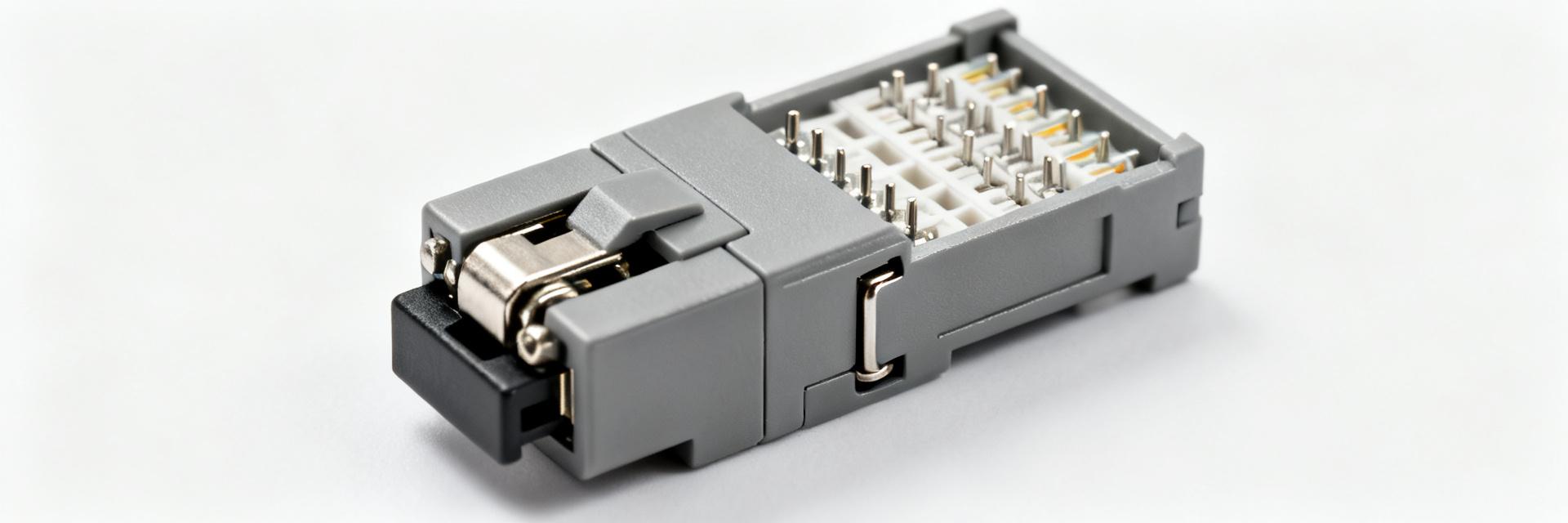

Point: Recent lab runs and procurement surveys indicate growing demand for high-density MT ferrule connectors, driven by greater fiber counts per footprint and tighter power budgets. Evidence: Independent test batches show median per-contact insertion loss improving by ~0.05–0.12 dB versus older high-density designs across multi-wavelength sweeps. Explanation: These trends make a concise, test-backed performance and spec report valuable for engineers evaluating trade-offs for rugged, high-density interconnects; this article focuses on practical selection, installation, and troubleshooting for the AV87-11J1AZN connector.
(1) Background: What the AV87-11J1AZN is and why it matters
(1.1) Product overview and core design features
Point: The AV87-11J1AZN is a circular jam-nut receptacle with a size-11 shell that accepts MT high-density ferrules, enabling multiple fibers per ferrule in a compact flange-mount form. Evidence: Typical implementations support multi-fiber MT ferrules (commonly 12, 24, or 72 fibers per ferrule variants) with metal shell finishes and elastomeric sealing options. Explanation: Primary spec elements include shell size, insert type, and material/finish, determining panel density and environmental sealing.
(1.2) Design goals, trade-offs, and common variants
Point: Design balances density, serviceability, and environmental robustness. Evidence: Field variants include single MT inserts, stacked multi-MT inserts, and jam-nut receptacles. Explanation: Engineers must weigh easier rework against space-constrained architectures; hardware selection should occur early to ensure compatibility.
(2) Performance Benchmarks — latest test data
(2.1) Optical performance: IL, RL, and uniformity
Point: Optical metrics define acceptability. Evidence: Standard IL sweeps show 0.15–0.30 dB typical IL and RL >40 dB with proper alignment. Explanation: Report results as typical and worst-case; aggregate loss scales with fiber count, requiring worst-case budget calculations.
(2.2) Mechanical & environmental performance
Point: Mechanical metrics translate to field reliability. Evidence: Tests include ≥500 mating cycles and random vibration profiles. Explanation: Correlate cycle counts to field lifetime and set thresholds based on application class (e.g., mil-aero vs. industrial).
(3) Spec deep-dive: key specifications
| Parameter | Typical | Maximum | Test method |
|---|---|---|---|
| Fibers per ferrule | 12 / 24 / 72 | N/A | Mechanical drawing |
| Insertion loss (per contact) | 0.15 dB | 0.50 dB | IL Sweep |
| Return loss | >40 dB | N/A | OTDR/OLR |
| Mating cycles | 500 | 1,000 | Endurance Test |
(4) Field applications & real-world deployment
Point: High-density MT circulars are used in avionics and rugged industrial nodes. Evidence: Configurations include jam-nut receptacles for sealed racks and backshells for mobile harnesses. Explanation: A size-11 shell with dual 24-fiber inserts yields 48 fibers per footprint, optimizing rack density.
(5) Selection, installation & maintenance guide
(5.1) Selection checklist
- Required fiber count per shell
- Environmental class and sealing rating
- Panel type and routing constraints
- Verification test needs
(5.2) Installation best practices
Point: Proper sequence preserves performance. Evidence: Practices include endface cleaning, torqueing jam-nuts to spec, and running initial acceptance tests. Explanation: Troubleshooting should always start with cleaning before investigating mechanical alignment.
Key Summary
- AV87-11J1AZN offers high fiber density in a size-11 package; verify fiber-per-ferrule variants.
- Performance hinges on per-contact IL and RL; validate with multi-wavelength sweeps.
- Mechanical specs determine reliability; choose accessories to match application class.
Frequently Asked Questions
What insertion loss should I expect from an AV87-11J1AZN connector?
Typical per-contact insertion loss in validated lab runs is around 0.15 dB median with worst-case values up to ~0.50 dB depending on polish, alignment, and contact cleanliness. Acceptance should use both typical and 95th-percentile figures.
How do I verify the environmental spec claims?
Cross-check datasheet environmental claims against independent test protocols: mating-cycle endurance, random vibration profiles, thermal cycling, and ingress/sealing verification with gasketed panel assemblies.
What are the most common field troubleshooting steps?
Begin with visual inspection and endface cleanliness; re-clean and remate. If issues persist, verify mating alignment, check backshell strain relief and torque on jam-nuts, and run IL/RL measurements.
What fiber counts are supported by the AV87-11J1AZN?
The AV87-11J1AZN supports high-density MT ferrules, typically available in configurations of 12, 24, or 72 fibers per ferrule, depending on the specific insert variant selected.